What Is Metal Casting? A Complete Guide from Mold to Finished Component
Metal casting is one of the most important manufacturing processes used to produce mechanical, industrial, and engineering components. In this guide, we explain what metal casting is, the different types, materials used, applications, and how to choose the right manufacturer.
What Is Metal Casting?
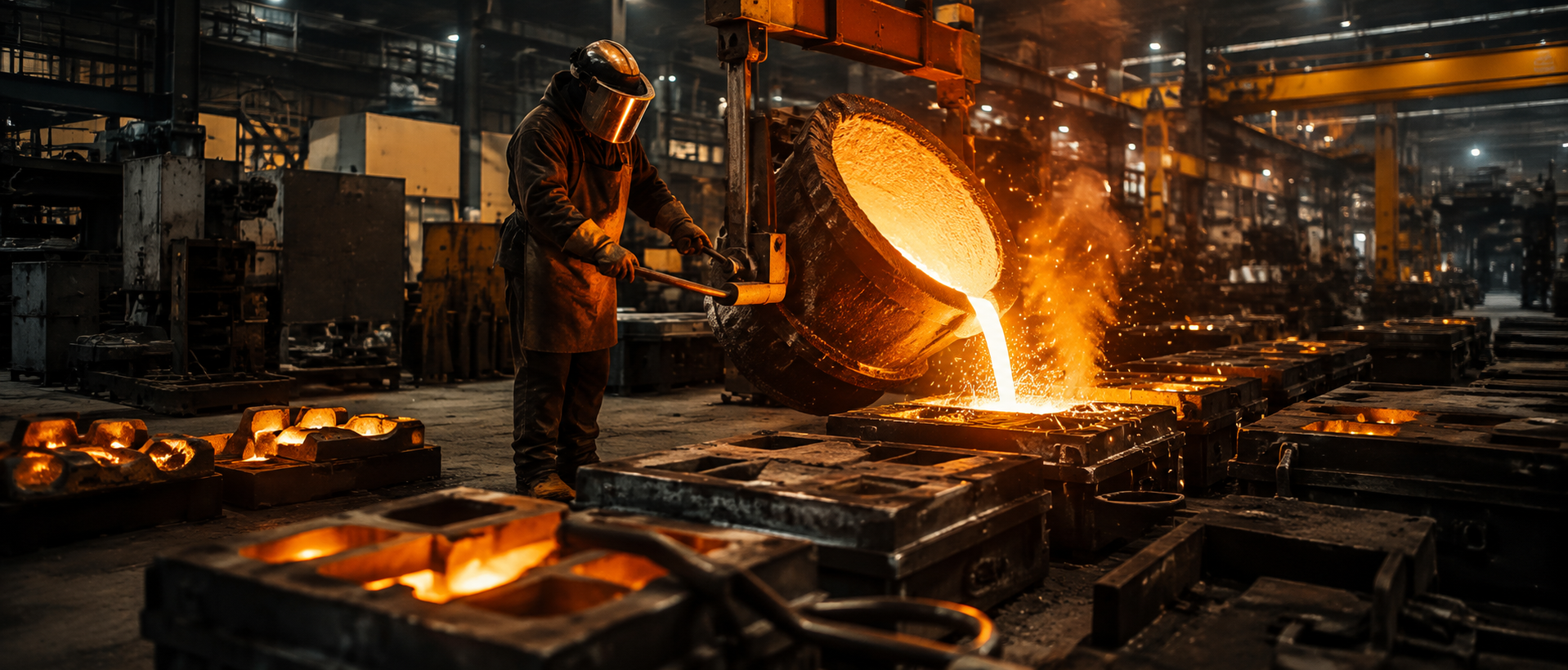
Metal casting is a manufacturing process in which molten metal is poured into a mold cavity and allowed to cool and solidify into a specific shape. Once the metal has solidified, the casting is removed from the mold and may undergo additional processes such as fettling, surface finishing, heat treatment, CNC machining, drilling, grinding, and quality inspection.
Metal casting is particularly useful for manufacturing components with complex geometries, internal cavities, curved surfaces, large dimensions, heavy structures, and custom designs.
Why Is Metal Casting Important?
Metal casting provides manufacturers with a flexible method for producing components that may be difficult, expensive, or impractical to manufacture entirely through machining or fabrication.
- Complex Component Manufacturing: Can produce complicated shapes and geometries that would require significant machining.
- Large and Heavy Components: Suitable for manufacturing heavy industrial components like machine housings and pump bodies.
- Material Flexibility: Different metals and alloys can be selected according to required strength and durability.
- Production Scalability: Manufacturers can produce prototypes, small batches, or large-volume components.
How Does the Metal Casting Process Work?
The metal casting manufacturing process involves several important stages from initial design to final quality inspection.
Component Design and Pattern Making
Engineering drawings, CAD models, dimensions, tolerances, and material requirements are reviewed. A pattern is created from wood, metal, or plastic.
Mold Preparation
A mold is prepared. For sand casting, sand is packed around a pattern to create a cavity representing the required component.
Core Making
For components with internal holes or cavities, a core is placed inside the mold to create the internal geometry.
Metal Melting
The selected material (e.g. cast iron, steel, aluminium) is heated in a furnace until it reaches a molten state.
Pouring the Molten Metal
Molten metal is poured into the mold through a gating system consisting of sprues, runners, gates, and risers.
Cooling and Solidification
The metal cools and solidifies. Proper cooling prevents defects like shrinkage, porosity, and cracks.
Casting Removal
The solidified component is removed from the mold. In sand casting, the mold is broken to remove the casting.
Fettling and Surface Finishing
Unwanted material (gates and risers) is removed. The surface is improved via grinding and shot blasting.
CNC Machining and Post-Processing
Additional precision machining (turning, milling, drilling) is applied to achieve high dimensional accuracy.
Quality Inspection
The component undergoes dimensional, visual, hardness, and non-destructive testing based on specifications.
Types of Metal Casting Processes
Different casting methods are used depending on the component design, material, production volume, required accuracy, and application.
Sand Casting
Widely used for large, heavy, and custom components using a sand mold. Offers flexible design and various metal options.
Investment Casting
Uses a disposable pattern and ceramic mold. Ideal for intricate shapes, precision components, and detailed shapes.
Gravity Die Casting
Molten metal flows into a reusable mold via gravity, offering better consistency and surface quality.
Pressure Die Casting
Molten metal is forced into a mold under pressure. Suitable for high-volume manufacturing with good dimensional consistency.
Shell Mold Casting
Uses a hardened shell-like mold created around a pattern for improved surface finish and accuracy.
Centrifugal Casting
Uses rotational force to distribute molten metal. Suitable for cylindrical or rotationally symmetrical components.
Metals Used in Casting
Ferrous Metals
Cast Iron
Known for strength and wear resistance. Used for machinery, engine, and pump parts.
Carbon Steel
Provides strength and durability for various industrial applications.
Stainless Steel
Selected when corrosion resistance is an important requirement.
Alloy Steel
Used when specific mechanical properties are required for demanding applications.
Non-Ferrous Metals
Aluminium
Selected when lightweight components and corrosion resistance are required.
Brass
Used for selected mechanical, industrial, and fluid-handling applications.
Bronze
Offers useful wear and corrosion resistance properties for specific applications.
Copper
Used where specific thermal or electrical properties are required.
Metal Casting vs Other Processes
Different manufacturing processes are suitable for different requirements. In many manufacturing projects, these processes can also work together.
| Manufacturing Process | Generally Suitable For |
|---|---|
| Metal Casting | Complex shapes and large components |
| CNC Machining | High-precision and tight-tolerance components |
| Forging | Components requiring high mechanical strength |
| Fabrication | Metal structures and assemblies |
How to Choose the Right Process
- Component Size: Large components require different methods than small precision parts.
- Design Complexity: Complex internal structures need specialized molds and cores.
- Material Requirements: The process must be compatible with the selected alloy.
- Production Volume: Prototypes vs mass production demand different cost-effective processes.
- Dimensional Tolerance: Tight tolerances may require post-casting CNC machining.
Applications of Metal Casting
Metal casting is used across a wide range of global industries.
Choosing a Metal Casting Manufacturer in India
Choosing the right manufacturing partner is important for component quality, production consistency, and delivery requirements. Consider these factors:
Manufacturing Capability & Capacity
Check if they can produce your required size, material, geometry, and volume.
Quality Control & Machining Support
Ask about inspection capabilities. A manufacturer that handles both casting and machining simplifies the supply chain.
Custom Manufacturing & Export Support
They should understand technical drawings, handle export packaging, and provide clear engineering communication.
Custom Solutions from RK MechXParts
RK MechXParts supports industrial buyers looking for custom mechanical and industrial manufacturing solutions. Depending on project requirements, we handle:
- Custom metal components
- Industrial castings
- Mechanical parts
- OEM components
- Machined castings
- Bulk production
Have a custom requirement? Send your technical drawings, CAD files, material specs, and quantities.
Request a Custom QuoteFrequently Asked Questions
What is metal casting?
Metal casting is a manufacturing process where molten metal is poured into a mold and allowed to cool and solidify into the required component shape.
What are the main types of metal casting?
Common types include sand casting, investment casting, gravity die casting, pressure die casting, shell mold casting, and centrifugal casting.
Which metals can be used for casting?
Common casting materials include cast iron, carbon steel, stainless steel, alloy steel, aluminium, brass, bronze, and copper.
What is the difference between metal casting and machining?
Metal casting forms a component by pouring molten material into a mold, while machining removes material from a workpiece to create the required dimensions and shape.
Can cast components be CNC machined?
Yes. Cast components can undergo CNC machining when precise dimensions, holes, threads, or critical surfaces are required.
How do I choose a metal casting manufacturer?
Consider manufacturing capability, material expertise, quality inspection, production capacity, machining support, engineering communication, and experience with your specific component requirements.
Looking for a Metal Casting Partner?
Have a custom mechanical or automotive component that requires metal casting? Send your CAD drawings, material specifications, and production quantities to RK Mech X Parts. Our engineering team will review your requirements and help you determine the best manufacturing approach.